
Synastry is the art of reading two charts in relationship: your planets land in their houses, their planets aspect yours, and suddenly two private skies become one shared weather system. Here’s how to take your first confident steps — and how to talk about hard aspects without scaring anyone.
One rule before you start
Synastry describes dynamics, not destinies. There are no “doomed” couples in a chart — there are friction points and flow points, and what a couple does with them is up to the couple. If you read synastry for others, your job is to give language to what they already feel, never a verdict on whether they should stay together.
The five conversations to check first
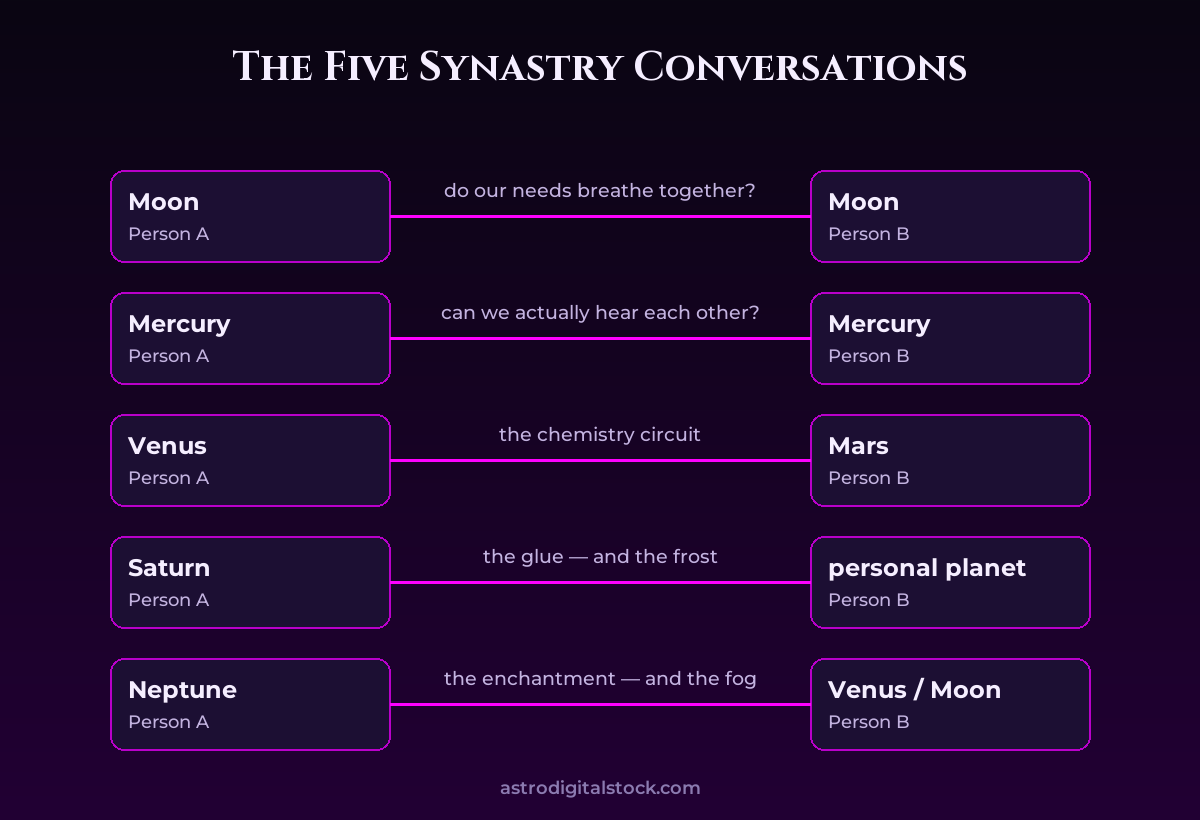
Beginners drown in synastry because everything aspects everything. Cut through the noise by checking five conversations, in this order:
1. Moon to Moon — do our needs breathe together?
The Moons are how each person rests, feels safe and recharges. Harmonious Moons want the same evening: both crave the blanket, or both crave the party. Clashing Moons live on different clocks — one needs to talk it out at midnight exactly when the other needs silence. This is rarely about love and always about logistics of comfort; naming it turns nightly friction into a solvable design problem.
2. Mercury to Mercury — can we actually hear each other?
Two Mercuries in tension see the same event and tell two different stories about it. Neither is lying — they process differently. Couples with hard Mercury contacts often argue about how they argue. The fix is almost boringly practical: learn the other person’s format. One needs headlines first; the other needs the whole story from the beginning.
3. Venus and Mars — the chemistry circuit
Venus is what delights us; Mars is how we pursue. Cross-contacts between one person’s Venus and the other’s Mars are the classic spark — and tense ones are often more magnetic, not less, at the cost of stability. Chemistry that arrives with friction burns hot and needs conscious tending; chemistry that arrives with flow lasts longer but must guard against taking each other for granted.
4. Saturn contacts — the glue and the frost
Saturn touching a partner’s personal planet is the most double-edged contact in synastry. It’s the glue of long relationships — commitment, loyalty, building something real — and it’s also where criticism creeps in: Saturn “helping” starts to feel like Saturn grading. If a couple says “we’re solid but I feel judged”, you’re almost always looking at a Saturn contact. The medicine: Saturn must ask before advising, and the personal planet must hear structure as love’s dialect.
5. Neptune contacts — the enchantment and the fog
Keep reading this lesson
This lesson is part of the Astro Digital Stock Learning Zone — available to members. Join to read every lesson, download the full asset library, and use our live content tools.
- Every astrology, marketing & promotion lesson
- The complete digital asset library
- Live social-media trend tools
- New drops every month