Before judging a horary you check whether it may be judged at all. The tradition calls these the considerations before judgement, and they are the most misunderstood part of the art — treated by some as an infallible gate and by others as medieval nervousness. Neither is right, and the difference matters in practice.
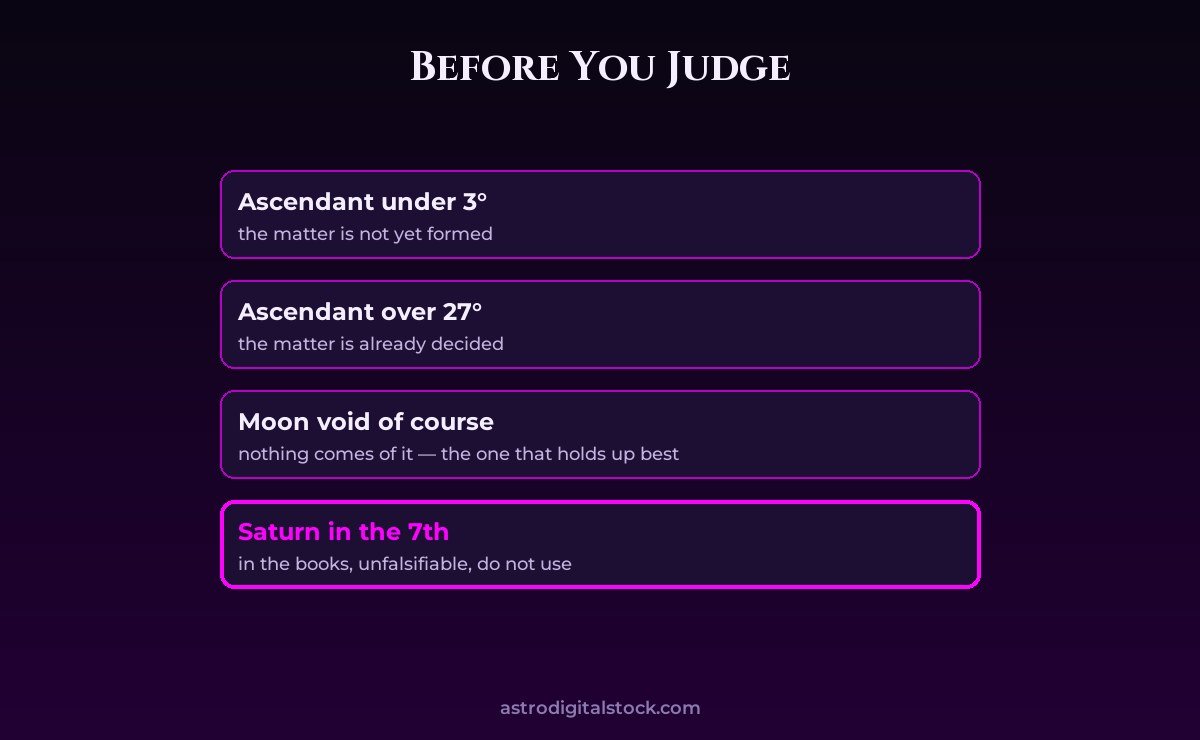
The three that carry weight
- An early Ascendant (under about 3°). The matter is not yet formed — the question has been asked too soon, before there is anything to judge. In practice this is the most reliable of the three: charts with a 1° Ascendant genuinely tend to describe something that has not happened yet.
- A late Ascendant (over about 27°). The matter is already decided; the querent is asking about something that has effectively concluded. Often true, and often the useful reading is “this is finished, and you know it”.
- The Moon void of course. Nothing will come of the matter. Of everything in horary this is the one that survives testing best — a void Moon in a horary very often does correspond to a matter that simply goes nowhere.
The one that does not
Saturn in the 7th house said to corrupt the astrologer’s judgement. This appears in the traditional lists and it is not a statement about the chart at all — it is a statement about the astrologer being wrong. It is unfalsifiable in the strict sense: if the judgement turns out right, the consideration is ignored; if wrong, it is invoked afterwards.
Know that it is in the literature. Do not use it. A rule that only ever explains failures after the fact is not a rule.
How to use the considerations honestly
The trap is treating them as a binary gate. Two better habits:
- Read them as information, not permission. An early Ascendant is not “do not judge”; it is “the matter is immature, and that is itself part of the answer”. Telling a querent that their question is premature is a useful thing to tell them.
- Check them before you look at the significators. If you assess radicality after you have seen the answer, you will find the chart unfit exactly when you dislike what it says. Do it first, write down what you found, and hold to it.
Worked example: a chart that objected
Keep reading this lesson
This lesson is part of the Astro Digital Stock Learning Zone — available to members. Join to read every lesson, download the full asset library, and use our live content tools.
- Every astrology, marketing & promotion lesson
- The complete digital asset library
- Live social-media trend tools
- New drops every month