
Nobody believes a stranger who says “I’m great at this.” Everybody believes a peer who says “she helped me.” Testimonials are the highest-converting words on your page — and the ones you must never fake, buy or exaggerate. Good news: collecting real ones can be systematised.
Why readings make testimonials awkward
Astrology sessions are intimate. Clients share things they haven’t told their partners — so asking “can I quote you publicly?” feels heavier than in most businesses. The solution isn’t to skip proof. It’s to design the ask so the client controls exposure: anonymity offered by default, review before publishing, and the option to decline entirely, no friction.
The 3-question formula
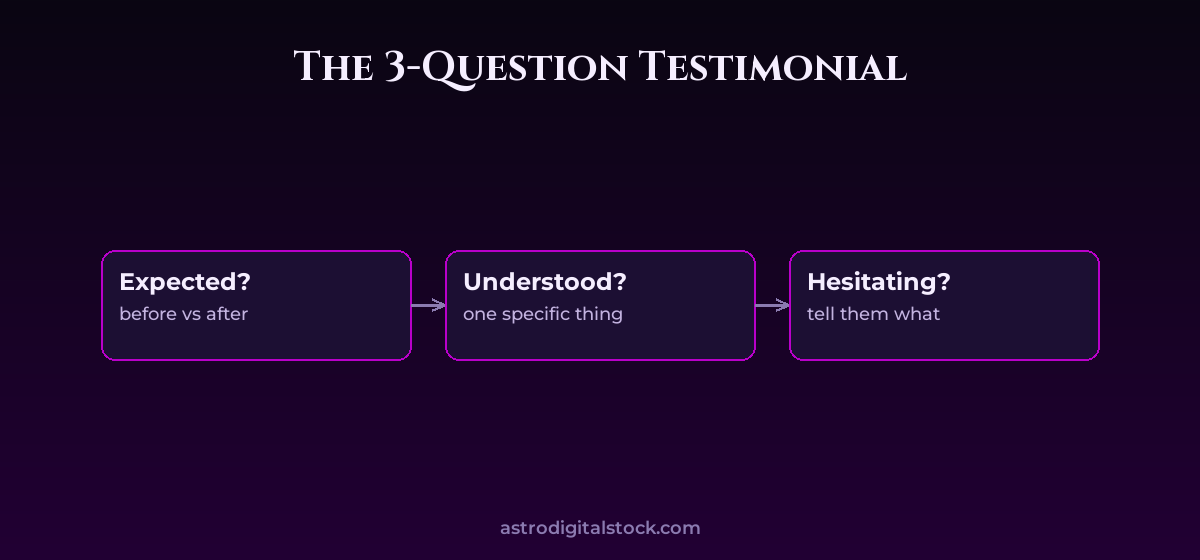
“Write me a testimonial” produces blank stares. Three guided questions produce gold:
- What did you expect before the session — and what actually happened? (captures the skepticism-to-surprise arc)
- What’s one specific thing you understood or decided because of it? (specificity is what sells)
- What would you tell someone who’s hesitating? (writes your ad for you, in client language)
The system: ask twice, effortlessly
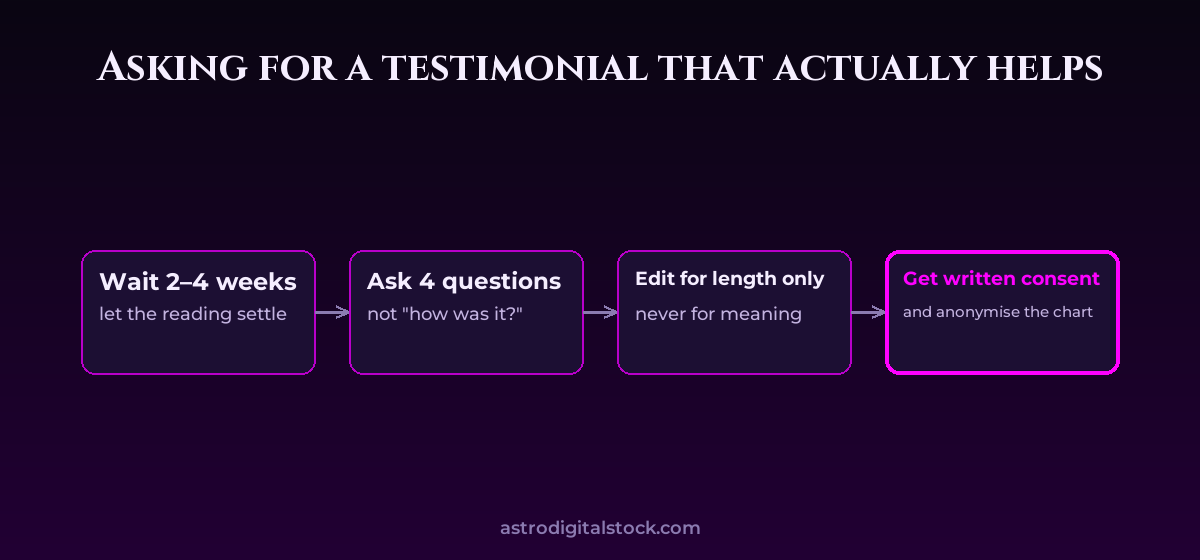
- Ask #1 — in the follow-up email, 7–10 days after the session, when the insights have landed. One line + the three questions.
- Ask #2 — after the result: when a client writes months later saying “you were right about the job” — that message, with permission, IS the testimonial. Reply: “May I share this (anonymously if you prefer)?”
Using proof without crossing lines
- Publish only with explicit permission — every single time, even for anonymous quotes.
- Never edit meaning; trim length only. The clumsy phrasing is what makes it credible.
- Attribute honestly: “Maria, 34, Berlin” only if real and permitted; otherwise “workshop participant” beats an invented name — invented names poison everything if discovered.
- Match proof to product: reading testimonials near reading offers, product praise near products.
Try it yourself
Message your three happiest past clients today with the 3-question formula. Two will answer. You now have more genuine proof than most competitors’ entire websites.
Worked example: the difference four questions make
Ask a client how the reading was and you get: “It was amazing, thank you so much!” That is warm, genuine, and completely useless as a testimonial, because it could describe anything and it persuades nobody.
Ask four specific questions instead and the same client writes something that sells.
What made you book in the first place? This produces the objection the next reader is currently having.
Keep reading this lesson
This lesson is part of the Astro Digital Stock Learning Zone — available to members. Join to read every lesson, download the full asset library, and use our live content tools.
- Every astrology, marketing & promotion lesson
- The complete digital asset library
- Live social-media trend tools
- New drops every month